
Advances in fiber laser technology have brought about a significant transformation in the metalworking industry over the past decade. Thanks to increasing laser powers, materials can now be processed at much higher speeds, with tighter tolerances, and at higher production capacities. Today, one of the most important parameters determining the performance of laser systems is the selection of the assist gas. The assist gas ensures that the molten metal formed during cutting is removed from the cut channel, regulates the interaction of the laser beam with the material, controls the resulting plasma, and directly affects the metallurgical structure of the cut surface. For this reason, the composition, purity, pressure, and flow rate of the assist gas are among the fundamental process parameters that determine cutting quality.
Pure oxygen has been the preferred choice for laser cutting of low-carbon steel (DKP) for many years. The primary reason for this is that oxygen undergoes an exothermic reaction with the material being cut, generating additional heat. Since this reaction provides extra energy in addition to that supplied by the laser, it offers a significant advantage, particularly with low-power lasers. However, the use of oxygen has some significant disadvantages. The metal oxide layer formed on the cut surface requires additional surface preparation, particularly before electrostatic painting applications. Furthermore, surface quality is limited due to high oxidation, and in some sensitive applications, a secondary process becomes necessary. As fiber laser powers have reached levels of 6 kW, 10 kW, and even 20 kW, the cutting mechanism has changed significantly. The cutting process is no longer solely dependent on an exothermic reaction. Thanks to the high energy provided by the laser, the removal of molten metal from the cutting channel via a high-pressure gas flow has become much more efficient. This has led to the emergence of new approaches in the selection of assist gases for cutting low-carbon steel.
In recent years, nitrogen-oxygen mixed gases (Mix Gas) have become increasingly common, particularly in the cutting of thin and medium-thickness low-carbon steels. These gases, which contain a controlled amount of oxygen, reduce the intense oxidation caused by pure oxygen while helping to maintain or even increase cutting speed. As a result, lower burr formation, a cleaner cut surface, and higher production capacity can be achieved within the same process. Mix gas systems currently in use are primarily based on the precise mixing of gaseous pure nitrogen and pure oxygen—supplied via manifolds—in gas mixers. While this method is technically successful, it requires two separate gas supply lines , a gas mixer, continuous calibration, gas logistics, and a high initial investment cost. These systems incur significant operating costs, particularly in high-volume laser cutting facilities.
PSA Nitrogen Generators in Low-Carbon Steel Laser Cutting Systems
Nitrogen generators operating with PSA (Pressure Swing Adsorption) technology can produce nitrogen with purities ranging from 95% to 99.999%. The mixed gas composition required for low-carbon steel cutting applications—typically at purity levels of approximately 95% to 98%—can be directly provided by PSA. The remaining portion of the nitrogen produced by PSA nitrogen generators consists largely of oxygen. Argon, which makes up approximately 0.93% of atmospheric air, remains at similar levels in the product gas at the end of the PSA process. Because argon is inert and does not participate in the laser cutting reaction, it does not adversely affect process performance. Therefore, a PSA nitrogen generator operating at a purity of approximately 95–98% can naturally provide the gas mixture required for cutting low-carbon steel without the need for an additional gas mixer. This eliminates the need for cryogenic or manifold-based nitrogen storage, investment in a gas mixer, and the requirement to mix two separate gases in precise ratios. The system can operate using only compressed air, appropriate filtration, drying, and a PSA nitrogen generator.
In PSA nitrogen generators, the atmospheric air entering the system consists of approximately 78% nitrogen, 21% oxygen, 0.93% argon, and very low concentrations of other gases. When compressed air is fed into the carbon molecular sieve (CMS), oxygen molecules are adsorbed, causing the nitrogen concentration at the tank outlet to increase while the oxygen concentration decreases. In PSA systems, nitrogen purity can be fully adjusted according to process requirements. As purity increases, the production flow rate decreases; conversely, when purity is reduced, much higher gas flow rates can be achieved from the same generator. A key factor in cutting low-carbon steel is establishing the optimal gas composition to ensure the desired cutting mechanism.
The typical composition of the product gas obtained from a PSA nitrogen generator operating at approximately 95% nitrogen purity is as follows:
| Component | Approximate Percentage |
|---|---|
| Nitrogen (N₂) | %95 |
| Oxygen (O₂) | %4,0-4,5 |
| Argon (Ar) | %0,8-1,0 |
Table 1. Gas Composition Ratios
Upon examining this gas composition, it can be seen that the remaining portion of the product gas consists largely of oxygen. In other words, the PSA nitrogen generator produces a gas composition very close to many of the nitrogen-oxygen mixture gases used in the laser cutting of low-carbon steel, without the need for an additional gas mixer. An important point to note here is the behavior of argon. Argon is a chemically inert gas and does not react during laser cutting. Argon at a concentration of approximately 1% has no significant negative effect on cutting quality. On the contrary, it is one of the gases preferred in many industrial shielding gas applications due to its inert nature. Therefore, the argon content in the PSA product gas does not pose any disadvantage for the laser cutting process of low-carbon steel.
The objective of this study is to experimentally compare the cutting performance of low-carbon steel using traditional pure oxygen versus nitrogen gas of approximately 95–98% purity produced on-site using PSA technology during the laser cutting process. Accordingly, the technical and operational feasibility of PSA nitrogen generator-supported cutting—without the need for a conventional gas mixing infrastructure—was comprehensively evaluated.
2. Experimental Study
As part of the study, the cutting performance of traditional pure oxygen versus nitrogen gas with a purity of approximately 95–98%, produced on-site using PSA technology, was compared in the laser cutting of low-carbon steel. The objective was to evaluate whether the gas obtained from the PSA nitrogen generator could serve as an alternative to the mixture gases produced by blending gases from the nitrogen and oxygen manifolds in specific gas mixers—which are used as an advantage over oxygen in carbon steel cutting.
The experiments were conducted on a 4 kW fiber laser cutting machine located at the Mikropor production facility (Figure 1). In all experiments, the laser power, focal point, nozzle type, focal distance, cutting path, and other machine parameters were kept constant, and comparative results were obtained by varying only the assist gas. This ensured that any differences observed were attributable solely to the gas composition used.
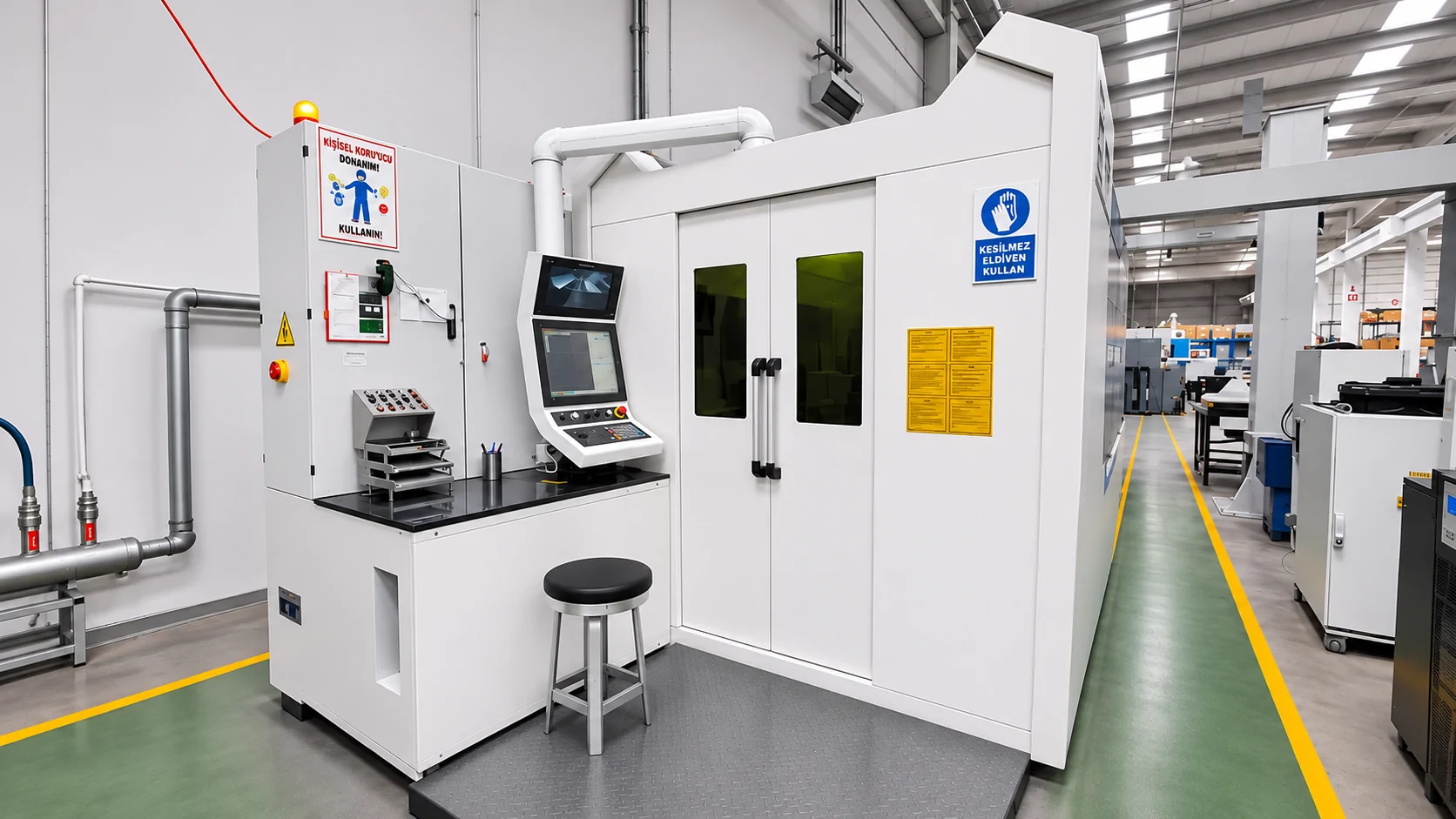
Figure1. 4 kW Fiber Laser Cutting Machine
S235-grade low-carbon steel, conforming to the EN 10025 standard and commonly known in the industry as DKP sheet, was selected as the test specimen. The experiments were conducted on 3 mm and 4 mm thick sheets to evaluate performance under different cutting conditions. In the experiments using pure oxygen, the gas was supplied directly to the laser machine via a manifold system.
The system used in the experiments consists of a compressor, pre-filters, a refrigerated dryer, precision filters, a PSA nitrogen generator, and a booster unit to meet the high-pressure requirements. The produced gas was fed directly to the laser cutting system without the use of any external gas mixer. Thus, the simplest and most economical system configuration applicable under field conditions was established.
Figure 2 shows a schematic representation of the gas supply system used in the experiments;
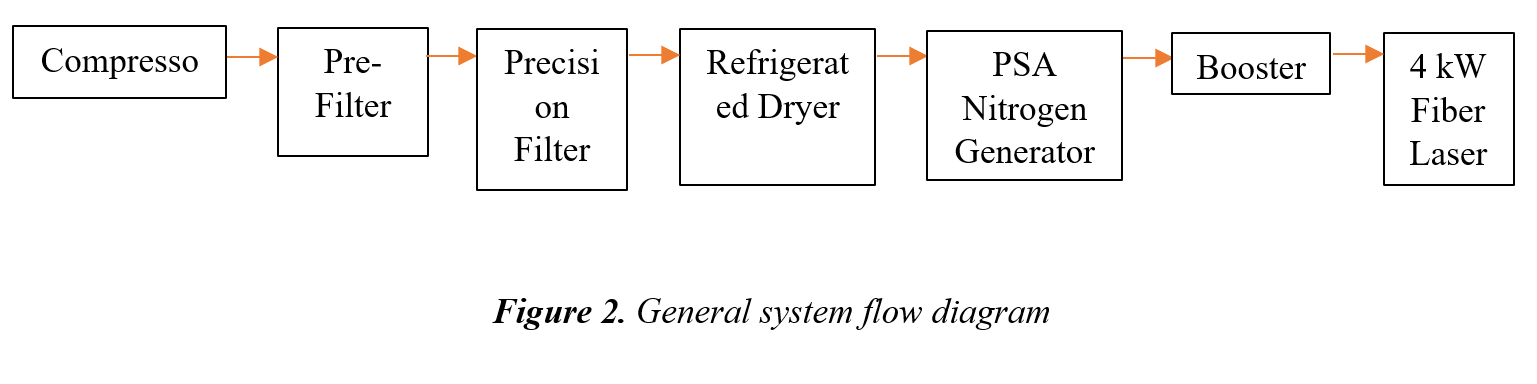
In this system, all gas production was carried out within the facility; no cryogenic nitrogen tank, gas mixer, or additional gas blending equipment was used. The PSA generator was operated at a nitrogen purity of 97%. The product gas obtained at this operating point consists of approximately 97% nitrogen, about 2% oxygen, and approximately 1% argon. The following performance criteria were evaluated in the experiments:
✓ Cut surface quality
✓ Surface burr formation
✓ Cut edge geometry
All samples were examined after cutting, the cut surfaces were visually compared, and cutting times were recorded. Additionally, operator observations were included in the evaluation to analyze process stability. The objective of this study is not merely to compare the cutting speeds of two different gases. It also aims to evaluate the feasibility of on-site gas production using PSA technology as an alternative to the conventional gas mixer infrastructure used in carbon steel laser cutting. For this reason, the experimental results were analyzed not only in terms of cutting performance but also in terms of system operational ease and cost.
3. Experimental Results and Technical Evaluation
3.1. DKP Sheet Cutting Results (3 mm)
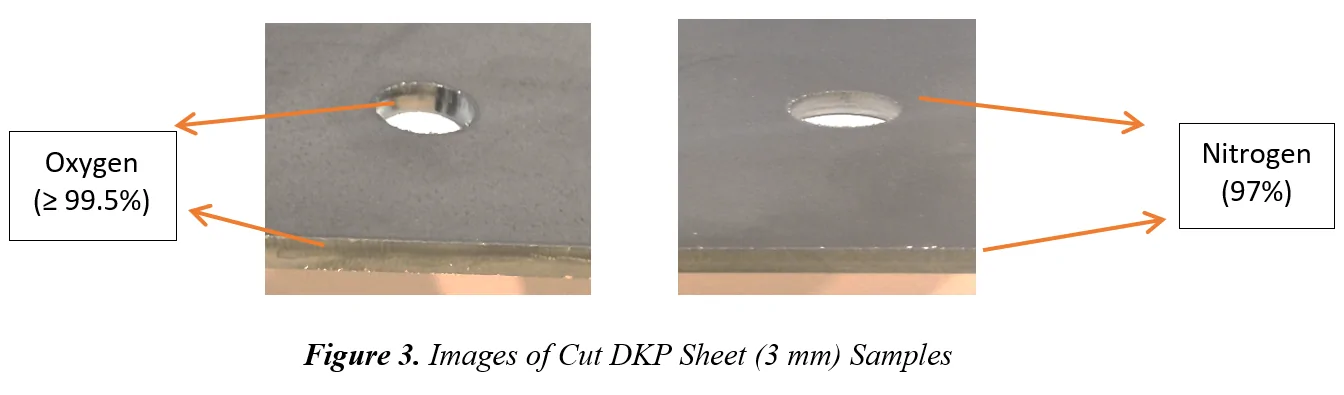
First, experiments were conducted on 3 mm-thick DKP sheet metal samples. While maintaining the laser power, optical settings, and cutting parameters, only the auxiliary gas was changed. This ensured that any performance differences observed were directly attributable to the gas composition.
As a result, when the cut surface qualities were compared, clean, burr-free surfaces were obtained in both cuts.
According to the experimental results, the cutting process performed using a PSA nitrogen generator on the 3 mm DKP sheet sample was completed 60% faster than the cutting performed with pure oxygen. This result is considered a significant advantage that can directly increase production capacity, particularly for businesses engaged in mass production. Images of the cut samples are shown in Figure 3.
3.2. DKP Sheet Cutting Results (4 mm)
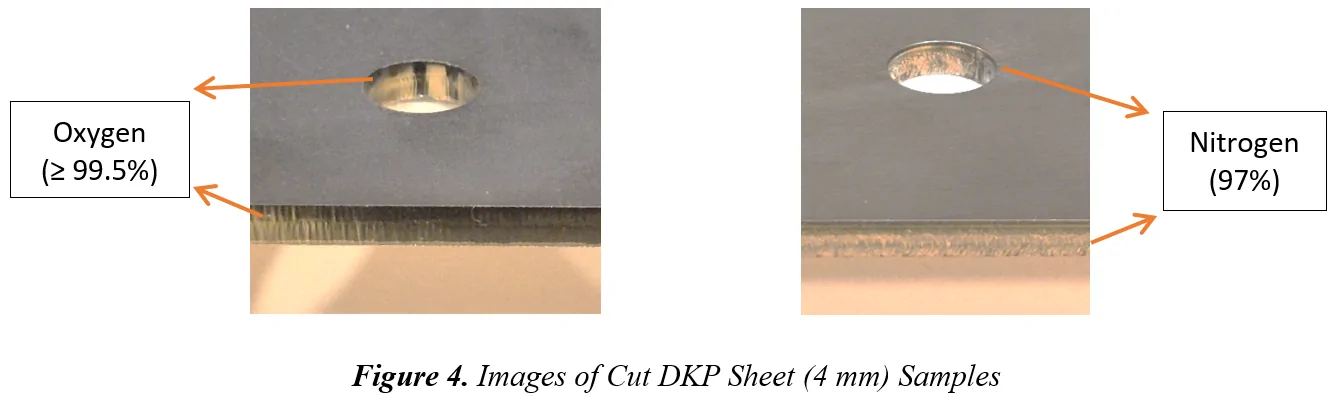
For cuts made with a material thickness of 4 mm, only the assist gas was changed while maintaining the laser power, optical settings, and cutting parameters. This ensured that any performance differences observed were directly attributable to the gas composition. When comparing both pure oxygen and 97% nitrogen, the amount of burr formed on the bottom surface remained minimal in both cuts, and the cut edges were smooth; however, the cutting time was significantly reduced when using 97% nitrogen compared to the system using pure oxygen.
The experimental results show that the system using a PSA nitrogen generator for cutting 4 mm DKP sheet metal provides a time savings of approximately 60%. This percentage indicates a significant increase in cutting performance—one that could be achieved in laser cutting processes solely through a change in the auxiliary gas. Images of the cut samples are shown in Figure 4.
4. Industrial Advantages of Using a PSA Nitrogen Generator
In carbon steel laser cutting facilities that use gas mixers, the gas infrastructure consists of a cryogenic nitrogen tank, an oxygen manifold, a gas mixer, pressure regulators, flow control equipment, and additional systems that ensure continuous verification of the gas mixture. This setup not only increases the initial investment cost but also raises maintenance requirements.
By producing and using nitrogen on-site with PSA nitrogen generators, the system is significantly simplified. The gas required for carbon steel laser cutting can be produced directly using a compressor, an appropriate filtration system, an air dryer, a PSA nitrogen generator, and a booster unit. There is no need for an additional gas mixer, cryogenic nitrogen storage, or mixture control equipment. This approach provides businesses with the following advantages:
✓ Consolidation of two separate gas supply infrastructures into a single system,
✓ Reduced reliance on continuous cylinder or liquid gas logistics through on-site production,
✓ Prevention of quality issues that may arise from changes in the mixture ratio,
✓ Lower maintenance requirements,
✓ Lower operating costs,
✓ Higher process continuity,
✓ On-site, uninterrupted, and consistent-quality gas production.
Especially in laser cutting facilities with high production volumes, these advantages provide significant benefits not only in terms of gas costs but also in production planning, maintenance management, and process reliability.
5. Results and Industry Recommendations
Within the scope of this study, the feasibility of using nitrogen gas with approximately 97% purity—produced on-site via PSA technology as an alternative to traditional pure oxygen in carbon steel laser cutting—was experimentally investigated. The study yielded significant benefits not only in terms of cutting performance but also regarding the architecture of the gas supply system, investment costs, and operational continuity.
The experiments demonstrated that the product gas obtained from the PSA nitrogen generator can deliver high performance in carbon steel laser cutting. In cuts performed on 3 mm and 4 mm DKP sheet samples, cutting times were 60% shorter compared to applications using pure oxygen.
In tests conducted within a purity range of 90–94%, the cutting speed was found to be 30% higher than that achieved with oxygen. This confirmed that the optimal purity range for use in low-carbon steel laser cutting applications is 95–98%.
One of the most significant findings of the study is the natural gas composition of the product gas obtained from PSA nitrogen generators operating at a purity of approximately 95–98%. Thus, the product gas offers a composition similar to many nitrogen-oxygen mixture gases used in carbon steel laser cutting. This finding indicates that the traditional gas mixer approach used in carbon steel laser cutting needs to be reevaluated.
In conventional systems, high-purity cryogenic nitrogen and pure oxygen are sourced separately; these gases are then mixed in gas mixers at the desired ratios and fed into the cutting system. While this approach is technically successful, it entails additional costs such as high initial investment, two separate gas infrastructure systems, gas mixers, flow control equipment, the need for calibration, and dependence on external gas supply. In on-site gas production systems using PSA technology, however, the same process can be carried out with a much simpler infrastructure. As a result, the gas mixer, the cryogenic nitrogen tank, and most of the associated auxiliary equipment can be eliminated from the system.
The advantages of on-site gas production are not limited to initial investment costs. The elimination of continuous gas logistics, the elimination of the need for cylinder or liquid gas exchanges, the process becoming independent of the external supply chain, and the ability to consistently maintain the same gas quality provide significant benefits in terms of production continuity. Especially in facilities with high production volumes, this approach reduces the total cost of ownership (TCO) while also increasing process reliability.
As a result, the high-pressure PSA nitrogen generator solutions developed by Mikropor are not merely equipment that provides on-site gas production for carbon steel laser cutting applications; they also offer an integrated process solution that eliminates the need for a gas mixer. Businesses can continuously and reliably produce the gas composition they need through a single system, thereby reducing investment costs while increasing production efficiency.
Mikropor R&D Department